Saturday, January 13, 2007

Blog Post Frequency

How to know when to check this blog?
As you can see, the average frequency of our new posts is about every 10-15 days. Less is more. This means that if you faithfully check those page with such rythm, you are sure to find amusement or erudition of unpredictable nature.
A fact not excluding that we can post precious relics or actual reflections two or three days in a row. Or that we can remain silent for two full weeks, due to travels above the seas (in search of novelties and wonders).
If you like, you can even check every morning to contemplate the very same images being rejoyced by them.
Whatever your choice we trust you, in any case, you'll not betray us.

Friday, January 12, 2007

More Spanish imagery from the 50s

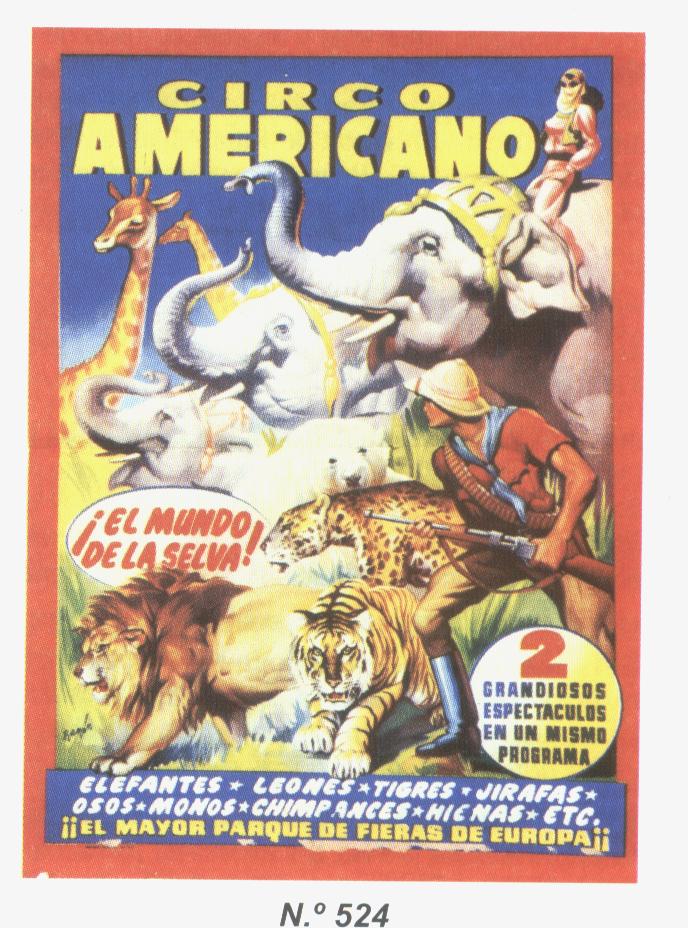
Circo Americano was a name initially invented in 1919 in Spain by circus impresario Sanchez, when every big top in Europe was forever changed by the recent tours of Barnum or Buffalo Bill.

In 1949, Circo Americano was revamped by circus director Manuel Fejio, under the management of his son-in-law Arturo Castilla. The unforgettable Senor Arturo had the theatrical experience of operetta productions, a consuming passion for circus and the inhexaustible imagination of a child.
In his Circo Americano, every costume and uniform had to be part of a fairy tale. A revolving stage connected to the ring revealed gilded curtains and visions of ingenuity from around the world, enriched by water fountains and a powerful orchestra.
In the Spain of the 50s and 60s, Circo Americano trascended the American imagery, and became a magic formula to materialize every possible fantasy from the corners of the universe.
As if forgetting the pretext of stars and stripes, year by year Americano promised the magic lamp, the court of the Khan, miracolous hypnotists, the cossacz of the Czars, the races of the world. American indians semed at ease in the darkest Africa, and Buffalo Bill impersonators had their cue after the eruption of Pompeii…
In 1963, Castilla merged Circo Americano with the italian Togni family, creating a true American three-ring circus with herds of elephants, still touring in Europe.
But this is another story….

Wednesday, January 10, 2007

Incredibly Strange Posters


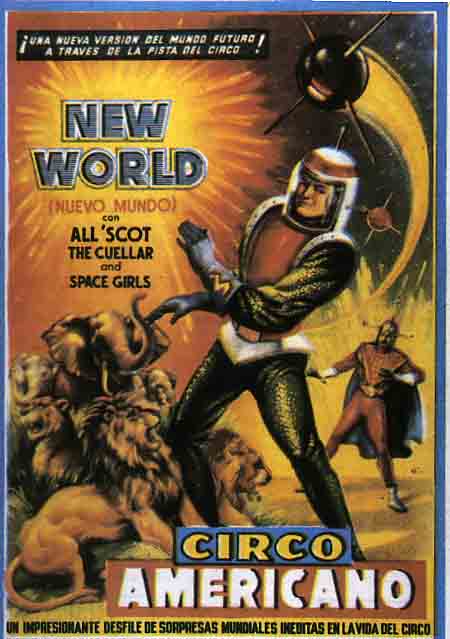
Never surprising enough seems the imagination behind circus posters. And complicate indeed is to figure out the promise of this Spanish illustrations from the 50s.
Accumulation and intersection of references, beyhond space and time, have always been the bread of circus publicists. But even the finest poster connaisseur can hardly remember a sublime surrealistic achievement as this one.
The poster announces above: "a new version of the future world through the circus ring".
Space-age pulp stories were a post-war daily escape of the western world: why not in the cold-war Spain, under General Franco dictatorship?
And why don’t give the possibility to exist to an unknown breed of lions on some faraway galaxy? In a place where discover a perhaps better "new world", with perhaps better circuses?
Too bad that we'll probably never know more about "All'Scot the Cuellar and Space Girls".

Sunday, December 31, 2006

Prestigious Prestiges of the Past : Pepper’s Ghost

Further curiosities on science and magic

The recent movie “Prestige” developed, in many of our readers, curiosities and inspirations about the connections between science and magic: two fields which most glorious era coincided, as we remebered in our recent Robert-Houdin article.
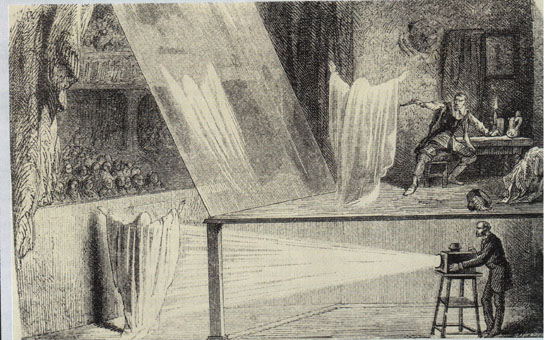
The great first Victorian exemple was perhaps “Pepper’s Ghost”. Virtually every handbook or encyclopedia of theatre depicts the working of this stage invention, here proposed in a popular print from our collection. The invention of this mechanical projection of a ghost upon a stage was originated by Henry Dirks and John Henry Pepper of the Royal Polytechnic Institution in London, 1863. Its complicate history of fights and patents, subterfuges and variations, is not far from the atmosphere depicted in “Prestige”. But for their passionate narration, we suggest the literary achievements of Jim Steinmeyer.
Instead, we call your attention on the less known theatrical application of the said invention. Principally, it was used neither for standard magic shows nor for the stagings of opera or drama. After his birth as science demonstration, “Pepper’s Ghost” was used by theatrical companies specialized in dramatizations of the invention in popular circuits.
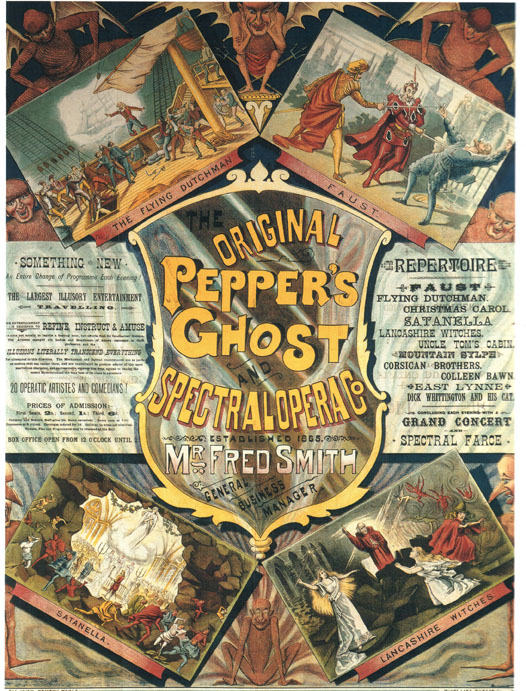
This poster from 1893, is from one of them: the now forgotten “Mr.Smith’s Original Pepper Ghost’s and Spectral Opera Company” (preserved in the London Public Record Office).
What exactly did a spectral opera company? They built the apparatus on and under the stage, then presented some sort of ghost variety show. It consisted in a selection of famous scenes from dramas, novels, or operas in wich at least a ghost included. We have of course some doubts on the acting talent of companies as Mr.Smith’s in playing the likes of Faust or Lancashire Witches. And we are more perplexed at the eventual singing abilities in selections from Flying Dutchman; or at the accuracy in the dramatization of literary classics as Uncle Tom’s Cabin or Christmas Carol.
But we firmly believe that the prestige was perfectly crafted, and the manifestations of spectres, evil or saints, was for the audience more thrilling at the times than any movie magic of today.

Saturday, December 23, 2006

Christmas Circuses


With a tribute to Bertram Mills

Few things are more connected to Christmas than a visit to the circus.
When I was a child, I had a great chance. In the 70s, Christmas circuses in Italy used to have the highest possible standard in the world. Stepping into one of those huge decorated big top, best if covered by recent snow, was for me a weird sensation. It felt as to step inside a christmas tree, or have a strange walk into a full life nativity diorama. The mysterious unfolding of the acts was a no minor pleasure of unwrapping toys and gift. And what gifts I was treated to, when at the circus!
I didn’t knew to be admiring legendary names: from the contorsions of Archie and Diana Bennett “directly from Las Vegas”, to the legendary Rastelli clowns; from Bulgarian teeterboard pioneers as Boitchanovi or Silagis, to cycling champions as Bertini, King Charles or New Dollys; the horse pyramids of the Caroli or Casartelli families; aerials from Miss Mara to the Flying Palacios, to the triple of Raul Jimenez…Elvin Bale…the Munoz on the wire; the risley icons Rios brothers; the lions of Darix Togni or the bears of Ursula Bottcher; the 25 elephants of Circo Americano; the lavish coreographies of Arturo Castilla or Liana Orfei, the water or ice circus pantomimes...
I can mention just few of the many I was used to see year by year, and all at few blocks from home.
But destiny, birth and age didn’t gave me the chance to know the best of all christmas circuses in history. I speak ofthe London Olympia circus created by Bertram Mills between 1919 and 1964. Only pictures and fading memories of few survivors are today remaining to describe this immense hall transformed for few week in the home of the best circus heroes of XX century. I think that for a child in London, this should have been better than a visit to Willy Wonka’s factory.
Beside the main circus hall, Mills used to build into the Olympia a menagerie, then the “fun fair” with his rides, a complete sideshow (mostly with Ringling attractions from overseas) including sometimes a lilliput village. An army of the greatest British clowns, the last heirs of classic pantomime, animated the shows. The trapeze net was all the time above your heads, remembering all the time the thrill of the circus. Sometimes Merle Evans was called as the band leader.You was sure to see the best animal acts in the world, and Willy Schumann was the equestrian director.
And the Queen, of course, came every year, and greeted each one of the performers backstage, from the unycicle juggler to the last of Ubangi savages.
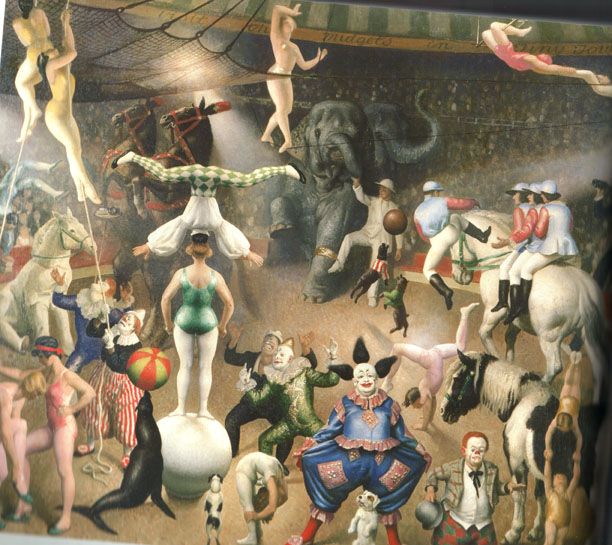
As a tribute, we offer here a couple of images remembering this Mills era. One is from the imagination of famous painter Dame Laura Knight, that used to visit the Olympia show: this is a partial view of her huge painting “Charivari” (1928).
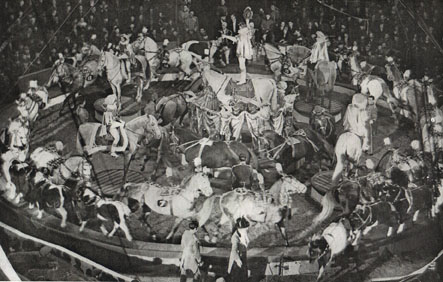
The other is a photo of the reality. Taken in the mid-30s, it depicts one of the incredible Schumann horse living carousels.
What about Christmas circuses today? The bests are actually in Germany, Switzerland, Holland, in temporary big tops or halls. And Big Apple at Lincoln Center in New York, of course. But if you wish to feel the real magic of a Christmas circus, the destinations are the two oldest circus buildings in the world: the Carrè Royal Theatre in Amsterdam, with the Knie family, and the Cirque d’Hiver in Paris, with the new generation of Bouglione dinasty. Wherhever you are, I guarantee that they both are worth the trip.

And Happy Holidays, of course.

Saturday, December 16, 2006

More Koringa

In 1937 Koringa was discovered by Cyril Mills in some French big top, and was booked at the London Olympia for the Holiday Season. Mr.Cyril remember in his memories that his legendary father Bertram Mills had some doubt, considering the act “someway borderline” . But an impressive advertising campaign was built, and the act was the success of the season.


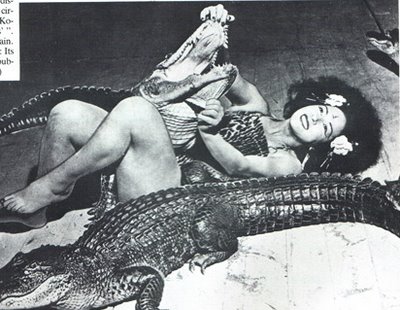
Koringa’s act was basically the same of Blacaman’s: a first part of fakir classics as the sword ladder or the burial alive under the ring, then the hypnotism with reptiles: snakes before, than crocodiles.


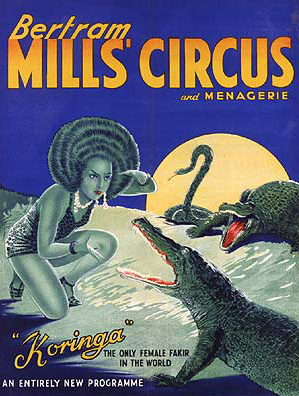
The following picture from the Mills program is eloquent in all the erotic stimulation of obscure fantasies that the British audience between the wars could have hidden under the icy curtain of a London Christmas.

Koringa was such a success, that the act was kept on tour by Mills for the following big top season.

Friday, December 01, 2006

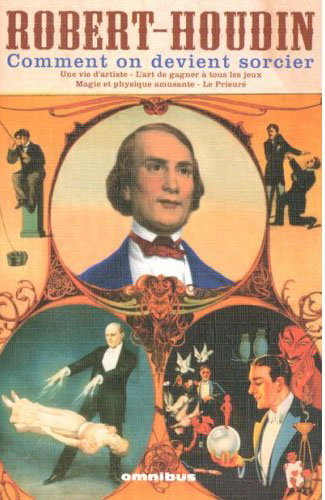
Robert-Houdin

On the literary legitimization of legerdemain (celebrating two new editions of the old).


As in religions, the mytologies and legends of show-business are often started by biographies. Vocation and careers are said to be initiated at tender age by the noctural reading or the daydreaming of life and adventures of stage saints.We often forget that the so-called “father of modern magic” Robert-Houdin ( Jean-Eugene Robert, 1805-71) owes his worlwide fame more to the infinite editions and translations of his mémoirs, than to his effective performing career (shorter than other average long-life performers). His autobiography (Confidences d'un prestidigitateur- une vie d'artiste,1858) is a literary operation (enhanced by fiction) for a precise project: the social legitimation of magic elevated to the bourgeois “artiste” world from the outlaw vagabond jongleurs.
This vision evolved with more technical works. If later he wrote a treatise on gambling in the literary tradition of unmasking frauds (Les Tricheries des Grecs dévoilées ; l'art de gagner à tous les jeux, 1861), and after his career a pamplet on the built-in subterfuges of his haunted villa in Blois (Le Prieuré, organisations mystérieuses pour le confort et l'agrément d'une demeure,1867), more surprises was awaiting.
In the very last years of his life, he conceived two works that perhaps changed forever the concept of « magic literature ». Those two books ( Comment on devient sorcier. Les secrets de la prestidigitation et de la magie,1871, and Magie et physique amusante, postumous, 1877) are the first exemples of technical magic books not as pampleths to reveal “secrets” of sorcerers, nor simple pastimes. They are instead conceived as the divulgation of legitimate learning tools for everybody in the society willing to learn an harmless theatrical art.
For the first time, the subtle mechanics of hand dexterity and object mistification are described within the psycological frame of a true artistic context. A new art for a new world, when the industrial revolution was creating the concept of leisure, and the rise of photography was revolutioning the illusory reproduction of reality, the visual perception of the things and of the world. Monsieur Robert lived long enough to witness the progress of sophisticated science over simple mechanic. He slowly transformed himself from an horologist into an oftalmologyst. This contrast between the craft of automata and the evanescent mistery of new science is the most fascinating contribute of Robert-Houdin to the challenge of magic with the movies for her last “golden age”. It is a curious case if the Lumiere bros. photographic studio was installed in the floor above Robert-Houdin’s small theatre, and Georges Méliés inherited this same with his secrets.
Robert-Houdin books are the pillars on which the golden age of stage magicians was built between the XIX and XX centuries.
The erudite and boring notes above, may have stimulated some curiosities in bibliophily. An this brings us too into the subjects of actuality of the present post.
Until today, Robert’s books have been more or less availables, in various editions, but generally abridged. The complete editions have been preserved in some collection or libraries around the world.
Today, two centuries after the pioneer’s death, those works are the object of two distincts publishing efforts. One is French, the other American. The French publisher “Omnibus” presented few weeks ago the first ever complete edition of Robert-Houdin four books. It is an economic paperback edition conceveid for the general audience (as the author’s intention was, before the rising of the “magic fraternity” hypocrisy), at the bargain prize of 24 Euros for more than 900 pages (check it on www.amazon.fr). In the last few days, a very beautiful essay on the books appeared on Le Monde with the prestigious signature of Christian Fechner. You don’t read French? Coincidentally, last October, the magic publishing house Miracle Factory (
http://www.miraclefactory.org/) animated by Toddd Karr, presented a very elegant and sophisticated English translation, rich in illustrations and enhanced with commentaries by experts.

A pedantic appendice to our notes: Robert-Houdin wrote also a treatise on oftalmology: Note sur de nouveaux instruments propres à l'observation des divers organes de l'oeil ainsi qu'à la manifestation des images entoptiques (1867) . It is not included in none of the two new edition, but we honestly thinks that it should not be a a remarkable loss for the readers.


Monday, November 27, 2006

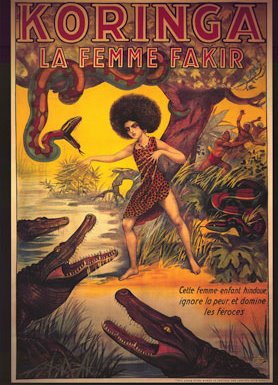
Forgotten Acts: KORINGA (1)


There was a time when
the experience of live entertainment assured the same thrills and fascination of the movies. Look at those posters: in the early 20s they gave you the same expectation of a Tarzan flick, but with the promise that Koringa was supposed to be alive, and all her beasts too.
Who was Koringa? Where she came from? She could have been the daughter of a maharajah abandoned in the jungle and raised by reptiles; why not the last empress of a lost amazon tribe; or a true goddess fallen from the olympus of magnetists offering to the earth the gift of her supernatural powers.
How she left the lost doomed temple where she used to live, arriving to the small vaudeville house just around the drugstore?
Little is known about the origins of the “only fakir woman in the world”. All what we were able to unveil, is that in the real world she was probably French. She started as an assistant of Blacaman (another kind of a legend), interpretating one of the nurses during his fakir acts. We believe that the Koringa reptiles act was put toghether as a sort of second unit of the Blacaman company.
More on Koringa in the next few days.


Saturday, November 18, 2006

Blog in ITALIANO

Sappiamo di continuare sempre più spesso a deludere coloro i quali non conoscono l'inglese: un pò di pazienza, e la vocazione multilinguistica di questo blog ospiterà di sicuro fatti e documenti curiosi anche in lingua italiana.
Ma, oltre a questo, abbiamo deciso che forse l'Italia merita qualcosa di specifico.
Perciò, tra breve esordirà un nuovo blog esclusivamente in lingua italiana:

www.delcirco.blogspot.com

Non sarà la traduzione di questo: avrà una natura un pò diversa, e sicuramente molto vivace.

Quando uscirà? Da quale parte del web? Come sarà?
Lo saprete se continuate ogni tanto a visitarci qui.

Heinrich Lang and the Auguste


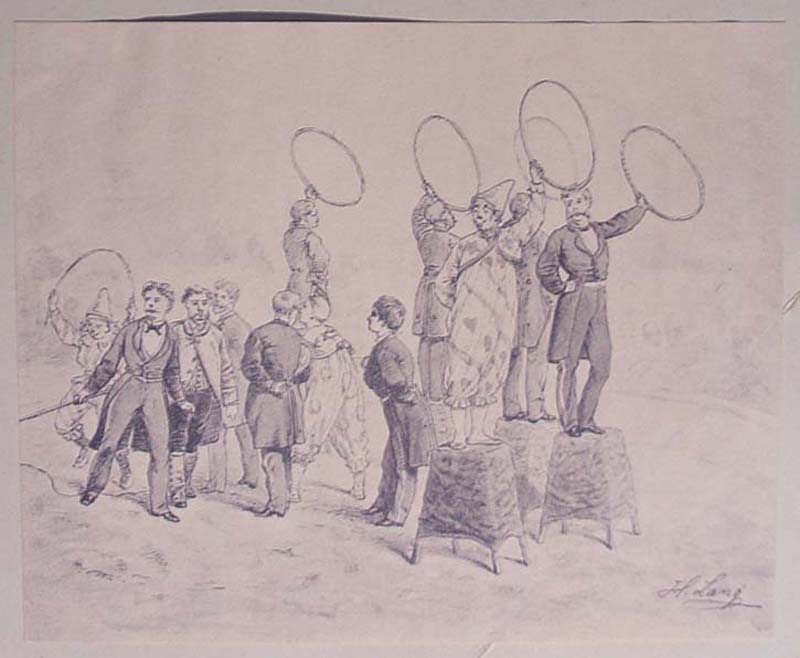
As promised, another print from my collection of Heinrich Lang works.
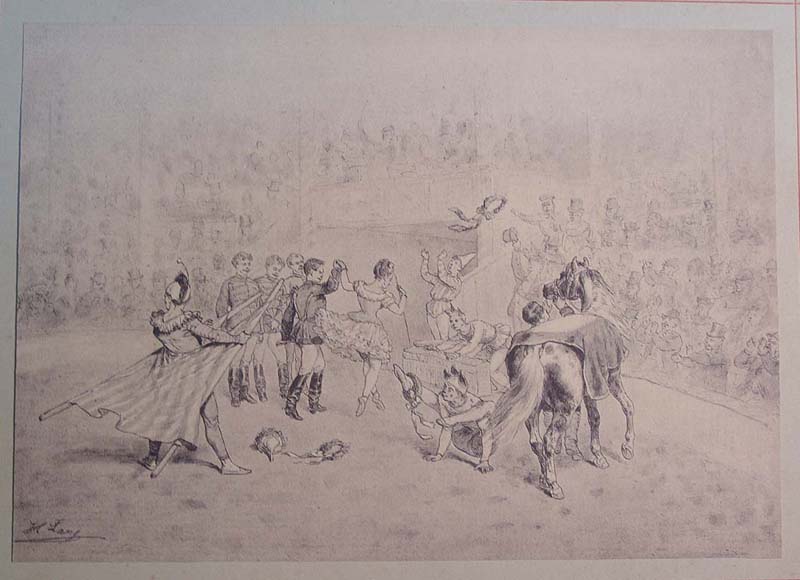
Lang was a minor German painter from the late XIX century, specialized in equestrian pleasures. Among his works realized two magnificent albums of heliogravures on the theme of circus in central Europe around 1880. It is an exceptional and detailed document of circus life in a period of dramatic evolution of the art, at the turning point before the fall of the priority of the equestrian culture and the full rise of acrobatics and gymnastic in the ring.
The two albums are among the rarest works on circus, and Toole-Stott rates them among "the 100 best circus works".
The present image is titled "The hoops", and is one of the 28 prints contained in the second album ("Kunstreiter und Gaukler", 1881). In the image, valets, ring masters and clowns are in the center of the ring waiting for the horse ballerina, that will turn around them and hopefully jumping in each of the hoops.
The scene is almost certainly depicted in one of the Renz circus buildings in mitteleuropa.
The man on the left wearing mustaches can likely be Direktor Ernest Renz.
The most interesting thing: the man in the center, standing in profile, wearing a frock coat can be one of the earliest images that I know of the auguste (if not the first). And almost certainly, I believe him being Tom Belling, the originator of august himself.
But I will be back soon on the subject...

Saturday, November 04, 2006

James the genius


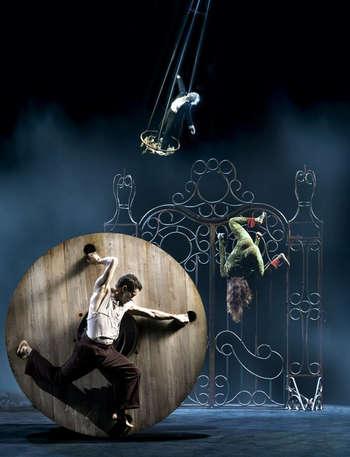
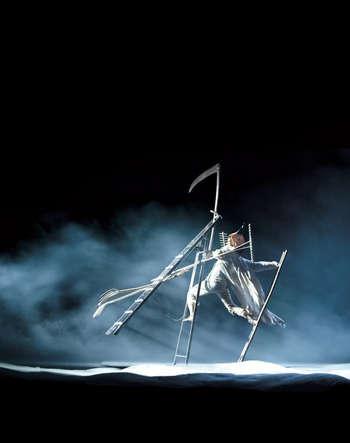
In a previous post we talked about James Thierrée (starring in the movie Bye Bye Blackbird).James is writer, director, acrobat, magician, mime, dancer, poet, aerialist...
I consider him the only living human being able to blend all those crafts (at their best) in the purest essence of Art.
His theatrical creations are a bridge between the past universe of silent movies, vaudeville and circus, and the actuality of the most accomplished contemporary stage expressions. Watching his shows, it makes me thinking of Charlie Chaplin going with Pina Bausch to spend a holiday into a Lewis Carroll book revised by Franz Kafka...
But, does those similarities really makes any sense?What is most beautiful, is that James' works, even is praised by critics worldwide, is completely immediate and anti-intellectual. They have the spontaneity and the genius of the children way of playing with universes, objects and living bodies.
James' first show was The Junebug Symphony created around 2000 (and recently available on DVD in France), followed by La Veillée des Abysses, still touring around the world with his talented company.James will create a new show in May 2007 at Theatre de la Ville in Paris, then on tour.
His parents (Jean Baptiste Thierrée and Victoria Chaplin) are occasionally still touring around the globe with their Invisible Circus; his sister Aurelia has her own stage creation Oratorio.
Waiting for James around you, enjoy here for the moment two pictures from La Veilleé des Abysses.

Thursday, November 02, 2006

The Fine Art of Strip Tease


Burlesque was the finest art in the world.
The skillful seductive revelation of own private nudities in order to attract the attention of a most distracted audience in small, noisy and smoky venues, is a now forgotten practice that should be learned in any academy of dramatic art, and put in practice by any kind of performer. The psycological subtilties behind stripping and teasing principles, are lessons in true dramaturgy, suspence, expectation. If carefully learned, the secrets of taking all off can be today a healthy way to save many arts of the theatre. Shakespeare or Moliere would have without doubt written for it.
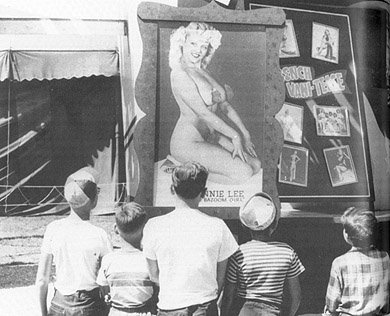
Burlesque reached his peak between the 50s and 60s: an age full of hopes, hedonism and a fascinating flavour of forthcoming decadence. In a certain way, was another side of the circus and his philosophy. From the classy night clubs of the world, to the travelling suburban girl shows; from the streets of Paris to the rural county fairs; from the emerging of a flashing Vegas Strips to the fading of a shadowy Times Square, around the globe gentlemen’s spare time was titillated by those innocent promises of sin.
This was a time of tempting capades and cavalcades, with a rich imagery in sex-o-rama, and a sure seduction enhanced by predictability: from the most unconvincing jungle sets eternally divided by the choice between zebras and leopards; to a space-age univers of aluminium foil; to the desperately infinite constellation of lingerie intime and bathing suits. All of that and more, set in the unlikeliest pre-Ikea furniture world made by uncessantly fliyng multicolor pillows, fake gilded thrones, colossal martini glasses and, of course, rides on giant cigars; or, in the most daring cases, innocent whips and boots inaugurating the age of bondage.
Crazy Horse de Paris was a late hip product of this age, before his touristic mutation into the likes of a boring visual handbook for Japanese housewives sipping cuba libres, or a reassuring tool for American businessmen having lives surrounded by feminine obesity. Even if Crazy Horse never interrupted his unique selection of the most beautiful women in the world, and the most unusual visual virtuosos of comedy and magic.
This European sanctuary is today brilliantly attempting to remove his patina of deja-vu with a new spirit.
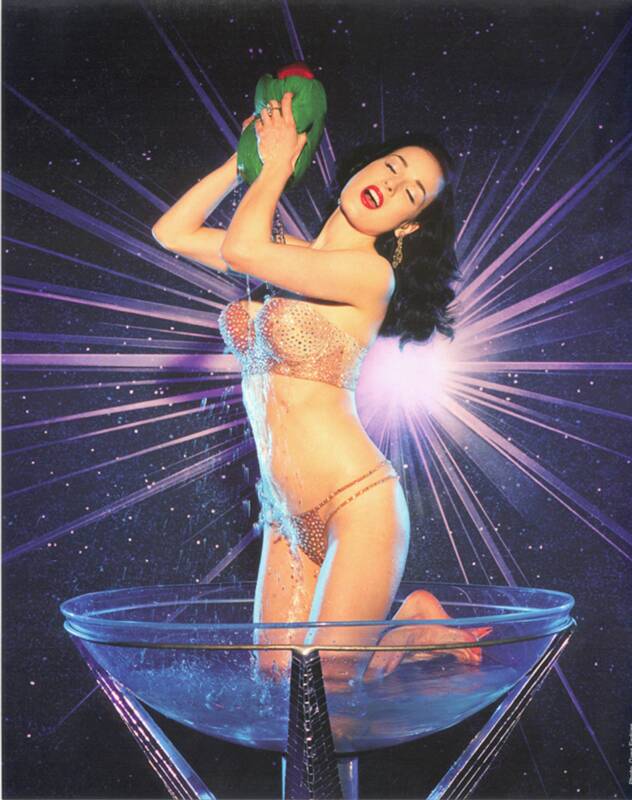
The other evening, evening, a gala at the Crazy celebrated the arrival of the true great modern burlesque diva: the here depicted Dita Von Teese live and in person (privately the spouse of icon Marilyn Manson). Her act revives in the freshest way all the ingenuity, surrealism, and excitement you could expect from an erotic pastime: and a true carefully glittered bathtub filled by true floating soap bubbles was the excuse for the revelation of her very true curves.

Thursday, October 26, 2006

Insect Mistake

We did a spelling mistake in giving the link to the Circus of Insect.
Their correct site is:

www.insectcircus.co.uk

Wednesday, October 25, 2006

Insect Circus


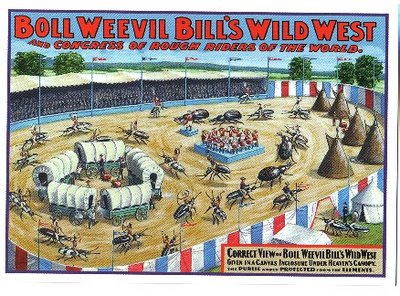
In times of revitalization of human circuses, a field so often infested by artistic parasithism, how welcome is a show done completely by honest and genuine parasites, encouraging a flourishing future for the always ambitious art of the arena.
We recently discovered “Circus of Insects” in London, just in front of Tate Modern. We was astonished by a knife thrower having a butterfly as target, a pyramid of ants, a juggling bee, a beetle clown and a full rock band of cicadas.
For the commodity of the wiewer, they are all grown human-sized, probably thanks to some specific vitaminic treatment.
None of the performers is, of course, object of mistreatment or cruelty: in fact, the circus is safely and regularly inspected by RSPCI, that awarded it with a gold medal 2003. This anyway doesn’t seem to stop the protests from the Performing Insect & Mollusc Defence League.
Besides that, this circus displays a unique annex: a museum of rare memorabilia witnessing centuries of history of insect circus world: the charming Insect Circus Museum. This being a true tabernacle celebrative of illustrious icons: from Josia Banks, father of the modern insect circus around 1770, to the legendary Tingling bros and Bunkum – Bugbee Combined Shows; from the London Christmas shows of Bramwell Hill’s at Olympia from 20s to 60s, to stage vaudeville specialty experts as master illusionist Gabardini, “master of mystery” in the ealry XX Century.
The museum contains props, posters, miniature models, musical instruments, rare programs, photographs and playbills of more than two centuries of memorable history. Some rare peepshows are also there, to witness of past industrious glories.

Some of you maybe don’t believe in this beetle, bug and bumblebee bonanza of bizarre: if so, we encourage you to discover more at http://www.insectscircus.co.uk/.
This circus is also proudly member of the Insect Circus Society ( founded in 1933 by legendary impresario “Lord” George Piper).

Saturday, October 21, 2006

Forgotten Acts

THE OTARIS (2/2)


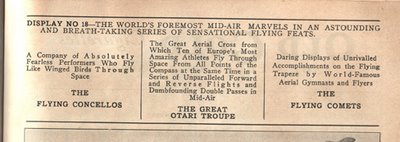
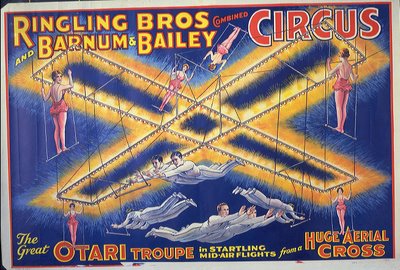
The Great Aerial Cross from Which Ten of Europe's Most Amazing Athletes Fly Through Space From All Points of the Compass at Same Time in a Series of Unparalleled Forward and Reverse Flights and Dumbfounding Double Passes in Mid-Air.
(quote from Ringling.Bros progam magazine, 1935)

In 1934, the Otaris crossed the Ocean to star with Ringling Bros. Barnum-Bailey.
For"Greatest Show on Earth" was the Gumpertz time, so I don’t know if they was previously booked by John Ringling in some of his European visits. The lavish litho reproduced above was engraved for them.
I scanned a page from the 1935 Ringling program to show what a display it was, with the Concellos in a side ring…Look:
According the poster and the program, the Otaris act was mainly a matter of syncronized double passes. But what a sight…
I don’t know about them later.

In the 40’s, the “cross” flying trapeze act was used by the Croneras, and in the 50s by the large Togni family. Young Enis Togni used to be one of the flyers. In recent years, a similar combination was used by a Ringling troupe.
The idea of white tail suits was few years ago back for the high wire act of the Guerreros in Monte Carlo.

Friday, October 20, 2006

The Surnateum


Scientific theatres, cabinets of curiosities, sideshows and theatrical magic have been gently stepping away of our world and lives, giving the place to the electronic fairs, web wonders, reality tv shows.
If Harry Houdini, Georges Meliés, Carl Hagenbeck or P.T.Barnum was alive today, where ever they would have look to satisfy their curiosity for the bizarre, or their primal need to discover and exploit a wonder-worker talent? They without a doubt would have paid a visit in Bruxelles to Christian Chelman and the place of which he is the keeper: Surnateum, The Museum of Supernatural History.
Along the years, I’ve regularly spent delightful hours in this ever-growing, unique and astonishing place, that is probably the world’s foremost collection of strange and
enchanted relics and artifacts.
Mr.Chelman is difficult to define. He is at the same time a Collector, Writer, Storyteller, Anthropologyst, Occultist, Archeologyst, Shaman, Hypnotist, Card Sharp, Teratologyst, Chryptozologist, Actor, Numerologyst, Ghost Hunter, Illusionist, Theologist, Mentalist, Inventor, Spiritualist, Taxydermist, Parapsycologist, Gymnopedian, Surrealist.


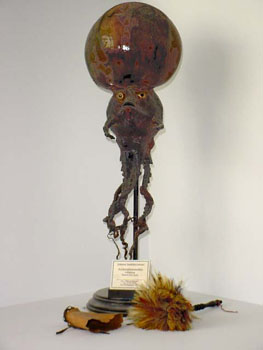
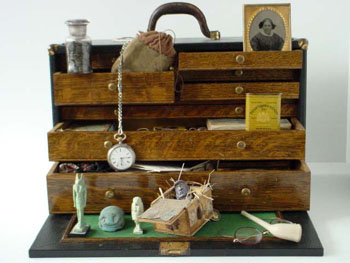
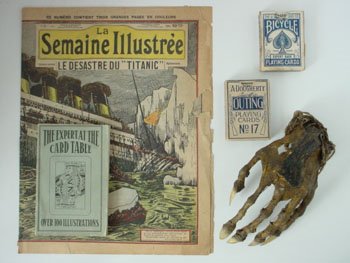
Surnateum hosts a range of bizarre items, and is specialized in hauntics (haunted antiquities): going from a hand of Yeti from Tibet to a vampire hunter kit; from ancient magician props to Egyptian papyrs for enchantment and spells, to the original photos of fairies signed by Arthur Conan Doyle. A human horned skull is not missing.
The concept behind all that, is a blend of seriuous collecting, literary surrealism (Breton, Cocteau), the tradition of mystery in arts, the genuine supernatural and, for non-believers, the respectable art of fraud.

What is more interesting, is that Mr.Chelman use parts of the collections for special interactive events, exhibitions or theatrical plays based on storytelling, conjuring, scientific demonstrations or supernatural powers. They are memorable experiences, between the modern theatrical purity of Peter Brook and the faded flavour of classic mystery novels or movies. Out of one of those performances, your vision of History is not anymore plain and linear as before.

Surnateum is open only by special appointment. But the world has now a window on it: through its beautiful and enormous website. It is available both in English and French (this latter section is more complete). Don't miss it: www.surnateum.org

Wednesday, October 18, 2006

Forgotten great acts

THE FLYING OTARIS(1)


The novelty fever that always invaded circus and variety world affected acrobats in the strangest and most seductive ways.
Falling the curtain on the Codona legend, the art of flying trapeze in the mid-30’s is not remembered for remarkable stars, if we except the Concellos.
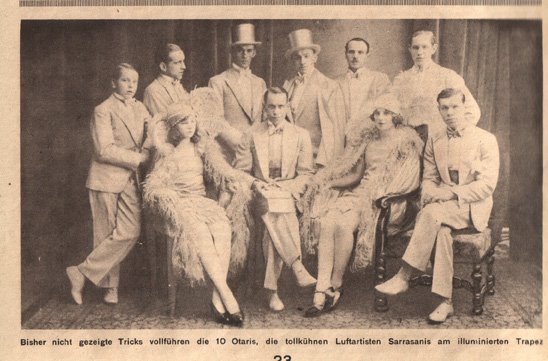
I’ve assembled some pictures of the german Otaris: I think that they likely are the originators of the “cross” trapeze act.
Yes, two trapeze bridges was presentes simultaneously.

The Otaris was 10, of which two women.
But what was most impressive, is the elegance and modernity of their act.
We can deduce that they was wearing white silk tails and evening dresses, and their “bridge” was graced by hundreds of bulblights.
You can see this in th artist’s poster, a Friedlander litograph dating 1929.
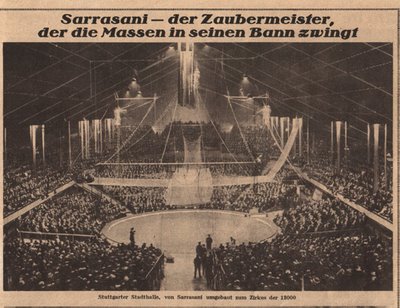
In the following years, no wonder that they was starring for the most elegant circus of its times, Sarrasani: the two balck and white photographs shown here (above and down) are from a Sarrasani program of 1930.

Otaris were a star act, even if Sarrasani never promoted them of a personalized publicity. He in fact used to say: “I don’t book stars: Sarrasani is the star…


In 1929 Sarrasani was the first circus ever in continental Europe to produce a winter show in a large hall, seating 12.000 (he was the first in many things).

In the panoramic view of the hall, you can see the Otaris on their “bridges” and their cross-net.
Then, in 1935, the Otaris left Europe crossing the Ocean...

Monday, October 16, 2006

Anomalies in portraits

Freaks are born with their trauma. They already passed their test, in the life. They are aristocrats”.
Diane Arbus


Last Friday the first edition of Film Festival in Rome was opened by actress Nicole Kidman, introducing the world premiere of Fur, the film in wich she stars with Robert Downey jr. (director is Steven Shainberg).

Fur is an imaginary period in the life of photographer Diane Arbus (Kidman), daughter of a fur shop owner. This movie tells about her encounter in the 50s with a fictionary neighbor, Lionel Sweeney, whose body is covered of fur.

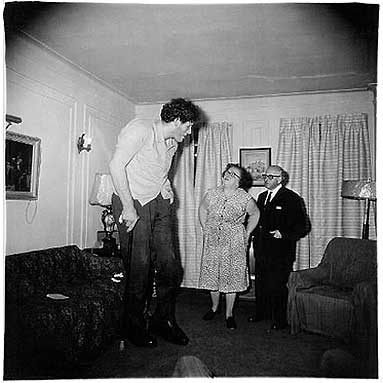
Arbus (1927-71), one of the master of American photography, was fascinated by human marginality and deformity: siamese twins, giants, albino fakirs, hermaphrodites, prostitutes, dwarves, amateur contorsionists in their backyards, burlesque dancers, mediocres masked balls of old peoples, small cafès aficionados or poor black families. Suburban slums, modest dressing rooms and cheap rural carnivals were the main subject of her art between 50s and 60s.
Her portraits of the “lady sword swallower” and the “giant jewish at home” (here shown) rests among the masterpieces of the photographic art. There are many lavish catalogues published, but try to get to see a live exhibition to really appreciate these pictures.
Now, the film producers didn’t got the permission to use the real pictures in the movie (so we are happily transgressing the law reproducing one here). For this reason, they probably invented the story of the furry friend. I suspect that his name, Lionel, can be inspired by the omonymous legendary “dog man” of museums and sideshows in the 20s.

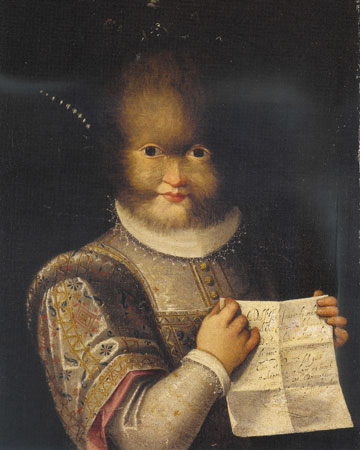
This pushes me to an erudite reference, Arbus not being the first woman in art to feed her inspiration with bodily anomalies as hipotrycosis (the excess of hair growht on the body).
In fact, italian court Renassaince painter Lavinia Fontana, left us this portrait of Antonietta Gonzales (circa 1594-5), establishing herself as a legitimateancestor of Arbus.
Antonietta, the dog-faced girl, was the daughter of a hairy man brought from Tenerife Island as a child to the court of France. Here he prospered, he went in Italy to the court of Mantua and agave birth to four children, one of them being Antonietta.
You can admire her portrait in France, in the castle museum of Blois (town that is also the hometown of Robert-Houdin). I appreciated the painting on exhibition in Italy few years ago, getting this souvenir postcard.

The movie, by the way, according to the critics doesn’t seems to make history. I will try to see it next week.

Saturday, October 14, 2006

Heinrich Lang


This is one of the many engraving of Heinrich Lang, a painter that around 1880 produced two wonderful album about equestrian german companies. I have most of them, so you will see more in the future.
If you click on it, you can enlarge and enjoy.
It is interesting to see how the concept of circus performances was different, with many peoples in the ring at once, in a true "company" spirit: as Gruss, Roncalli, Big Apple or Florilegio tried in modern times to rediscover.

About Enchantment and Wonder

"Magicians. They were true lords of the stage.
When the theatre was really theatre, able to enchant you with the pure theatricality".

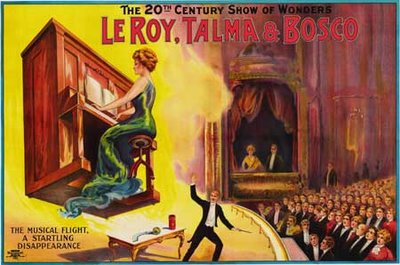
This is a quote of Orson Welles I had forgot, and I found again today in some of my notes. He pronounced it on the opening sequence of his unfinished film, The Magic Show.

Look at this poster, his surreal, nonsensical beauty.
How deep is his promise of theatrical enchantment.


Now put yourself around 1910, walking on a street. And you see that around a corner.
You probably go to the local theatre and buy a ticket, to witness the "musical flight".

At this times, transmitting "wonder" was the main concern of artists and producers.
Where is that need of "enchant" gone today?
The point is not to be nostalgic, but to keep the intrinsecal potential of wonder of a performing arts.
Doesn't matter if the object is magic, dance, drama, circus or opera.

Maybe today theatre must regain some magic, and magic some theatricality.
Locations of visitors to this page