Sunday, October 07, 2007

Indian posters 1


Indian circus and magic posters gives us the flavour of a bollywood subculture.
They looks based on some leaflet hazardously arrived perhaps from Italy or Great Britain in the suitcase of some second-rate juggler, and quickly redesigned in cheap watercolurs by the local printer for the Indian impresario...

Sunday Poster Gallery: Indian Circuses

The most we know about circus in India is the famous photographic work of Mary Ellen Mark, that in the 90s was the subject of her beautiful book “Indian Circus”.
Some dozens of circuses travels in India today, with generic names as “Imperial, European, Continental, Royal, etc”. They are a combinatioin of mud and approximate clown make up, hippopotamuses and children performers, fourth-hand tents and dwarves motorcycle acrobats.


Today’s gallery is about their advertising.

Friday, October 05, 2007

Victoria's animal secrets

In the 1830s, Isaac Van Amburgh became a star of the rising Broadway stage. He was not an actor, neither a singer or a pianist. He acted pantomimes among his menagerie’s beasts. Crossing the ocean, he became a popular celebrity, establishing in Europe the tradition of the “lion drama”. It is said that he put peace between man and the animals, the lion and the lamb: at a point that Queen Victoria asked to visit the four-legged performers backstage during the day “for the purpose of seeing the animals in their more excited and savage state during the operation of feeding them”. And, for the purpose of guarantee to the young Queen her most reserved emotions and fantasies, “the animals had been kept purposely without food for six and thirty hours”.

Sir Edwin Henry Landseer (1802-73), a prominent painter of the victorian era, assured to Van Amburgh the posterity with two beautiful oils, today in the Royal Collection at Windsor Castle. Reproduced here is “Isaac Van Amburgh and his Animals (1839)”.

Tuesday, October 02, 2007

Another Hirschfeld impression


David Shiner (today director of Soleil's Kooza) and Bill Irwin (today one of the best actors of the American stage) , at the time of their "Fool Moon" Broadway success, Tony Award '94, as seen by the late Hirshfeld.

Sunday, September 30, 2007

Early Soviet Gallery 5

The Margomax duo, magicians.
And with them is all for this Sunday gallery.

Early Soviet Gallery 4

A pre-communist Chinese circus company in the Soviet Russia.

Early Soviet Gallery 3


The great Vladimir Durov in one less-known, western-style of his multiple animal presentations.

Early Soviet Gallery 2

Sophia Marchess, a Russian mentalist from the early 30s. She rpobably kew the future, but today nobody seems know about the past about her.

Soviet Gallery 1

Gulym-Kadir Troupe

According my researchs, I believe that the Kadir troupe from Turkmenistan , in 1929, can be considered the first exemple of Soviet "production" act: with directors, coreographers, designers, coomposers, mixing in a unique thematic creation pantomime, acrobatics, animal training, etc. A sort of ancestor of Soleil-like shows.


Sunday Poster Gallery

Early Soviet Circus

We will try to devote each Sunday to a different unusual gallery.
Today is early Soviet circus posters. When one think to the soviet circus, officially established in 1922, one think to an uniformed, propagandistic style of act. In reality, thorough the '30, a great exotism, diversity and creativity was shown with a lot of influences.

Friday, September 28, 2007

LINKS

If you look up to the left of the page, under the "profile", you will find the access to a new chamber of the site, called "links".
This is our new guide, that we hope useful for your peregrinations in the most bizarre cunicola of performing arts actuality and history.
It will meet some of your usual interest and will hopefully stimulate new curiosities.
It will be, of course, perpetually progressing.

Thursday, September 27, 2007

Death Defying Acts


Conjuring and the movies

In a recent article, Variety acutely remarks how “the recent success of The Illusionist and The prestige located an audience for costume dramas revolving around stage sleight-of-hand and gimmicky suspense narratives, rather than the usual drawing-room or court intrigue”. Now, the imagery of magic can feed the visuality of designers and the talent of writers, (as the great novelists behind the two recent pictures), but what if the gift of imagination is not the priority in following the new trend? This is what looks to be the new “Death Defying Acts”, a movie just presented at the Toronto Film Festival and soon in the worlwide theatres. It is a fiction around Houdini and a lady pretending psychic powers. But, always according Variety, “result is a brisk, well-produced pic that lacks depth; nor does it provide the fun of deliberate, flamboyant one-dimensionality. There's no real tension, nothing specific to root for”.

It seems that to find an exciting marriage between magic themes and movies, we have to go back to the 1930s and Tod Browning, who rooted admirably his stories and characters, his criminals and renegades, into the spirit, philosophy and psycology of magic and carninvals in all his immense depht and contrasts (we’ll be soon back on that).
What seems happen today, is an excuse at least for contemplation:”if pic offers little of substance”, states the same magazine, “its packaging can't be faulted: Lensing, production design and costuming are all very attractive”.

The movie trailer:


Wednesday, September 26, 2007

Hirshfeld on Marceau


The secret of his art was the same of every great: the abstraction of reality and the gift of synthesis. For this reason, we wish to remember him with another master of those gifts, doing a sublime syntesis and astraction of Marceau himself.

Saturday, January 13, 2007

Blog Post Frequency

How to know when to check this blog?
As you can see, the average frequency of our new posts is about every 10-15 days. Less is more. This means that if you faithfully check those page with such rythm, you are sure to find amusement or erudition of unpredictable nature.
A fact not excluding that we can post precious relics or actual reflections two or three days in a row. Or that we can remain silent for two full weeks, due to travels above the seas (in search of novelties and wonders).
If you like, you can even check every morning to contemplate the very same images being rejoyced by them.
Whatever your choice we trust you, in any case, you'll not betray us.

Friday, January 12, 2007

More Spanish imagery from the 50s

Circo Americano was a name initially invented in 1919 in Spain by circus impresario Sanchez, when every big top in Europe was forever changed by the recent tours of Barnum or Buffalo Bill.
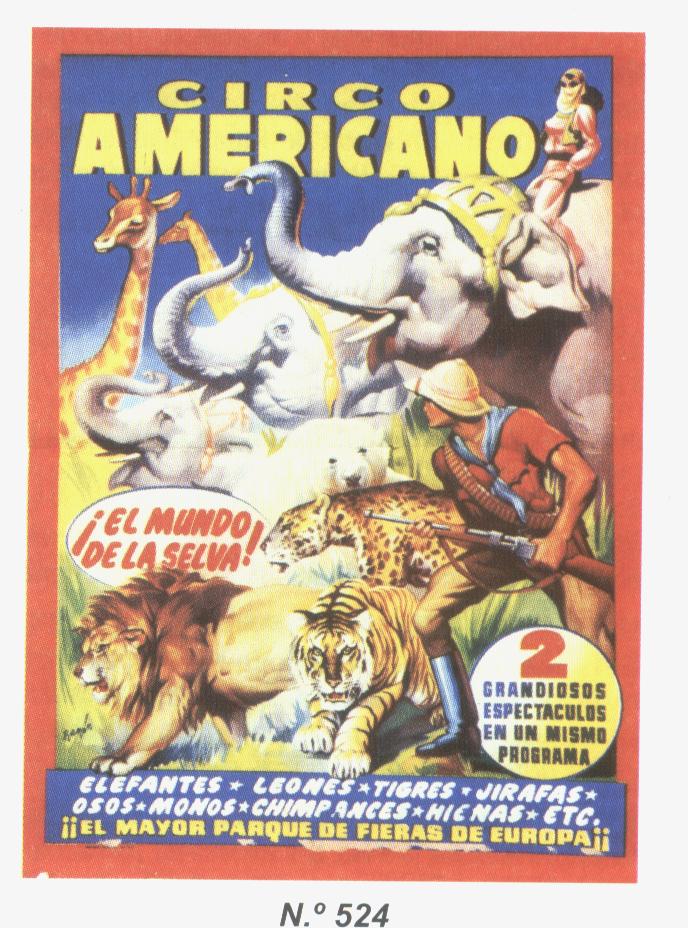
In 1949, Circo Americano was revamped by circus director Manuel Fejio, under the management of his son-in-law Arturo Castilla. The unforgettable Senor Arturo had the theatrical experience of operetta productions, a consuming passion for circus and the inhexaustible imagination of a child.
In his Circo Americano, every costume and uniform had to be part of a fairy tale. A revolving stage connected to the ring revealed gilded curtains and visions of ingenuity from around the world, enriched by water fountains and a powerful orchestra.
In the Spain of the 50s and 60s, Circo Americano trascended the American imagery, and became a magic formula to materialize every possible fantasy from the corners of the universe.
As if forgetting the pretext of stars and stripes, year by year Americano promised the magic lamp, the court of the Khan, miracolous hypnotists, the cossacz of the Czars, the races of the world. American indians semed at ease in the darkest Africa, and Buffalo Bill impersonators had their cue after the eruption of Pompeii…
In 1963, Castilla merged Circo Americano with the italian Togni family, creating a true American three-ring circus with herds of elephants, still touring in Europe.
But this is another story….

Wednesday, January 10, 2007

Incredibly Strange Posters


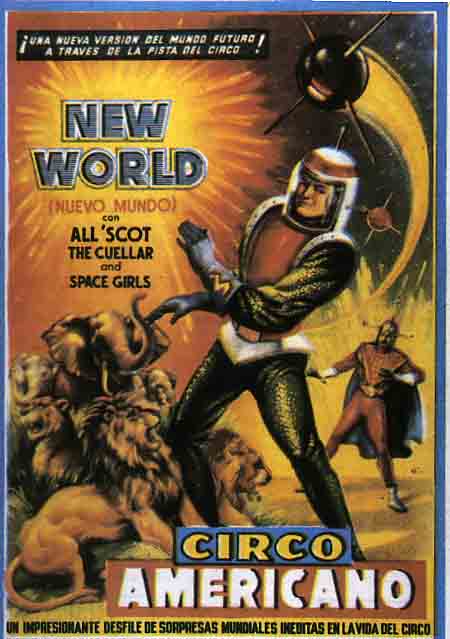
Never surprising enough seems the imagination behind circus posters. And complicate indeed is to figure out the promise of this Spanish illustrations from the 50s.
Accumulation and intersection of references, beyhond space and time, have always been the bread of circus publicists. But even the finest poster connaisseur can hardly remember a sublime surrealistic achievement as this one.
The poster announces above: "a new version of the future world through the circus ring".
Space-age pulp stories were a post-war daily escape of the western world: why not in the cold-war Spain, under General Franco dictatorship?
And why don’t give the possibility to exist to an unknown breed of lions on some faraway galaxy? In a place where discover a perhaps better "new world", with perhaps better circuses?
Too bad that we'll probably never know more about "All'Scot the Cuellar and Space Girls".

Sunday, December 31, 2006

Prestigious Prestiges of the Past : Pepper’s Ghost

Further curiosities on science and magic

The recent movie “Prestige” developed, in many of our readers, curiosities and inspirations about the connections between science and magic: two fields which most glorious era coincided, as we remebered in our recent Robert-Houdin article.
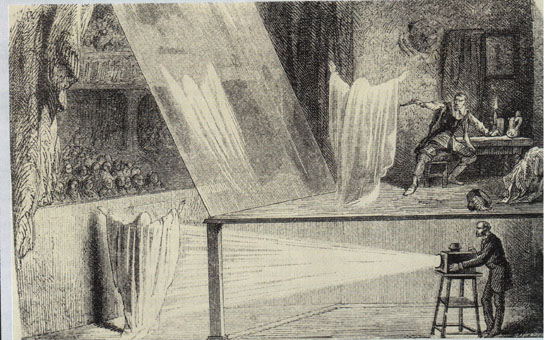
The great first Victorian exemple was perhaps “Pepper’s Ghost”. Virtually every handbook or encyclopedia of theatre depicts the working of this stage invention, here proposed in a popular print from our collection. The invention of this mechanical projection of a ghost upon a stage was originated by Henry Dirks and John Henry Pepper of the Royal Polytechnic Institution in London, 1863. Its complicate history of fights and patents, subterfuges and variations, is not far from the atmosphere depicted in “Prestige”. But for their passionate narration, we suggest the literary achievements of Jim Steinmeyer.
Instead, we call your attention on the less known theatrical application of the said invention. Principally, it was used neither for standard magic shows nor for the stagings of opera or drama. After his birth as science demonstration, “Pepper’s Ghost” was used by theatrical companies specialized in dramatizations of the invention in popular circuits.
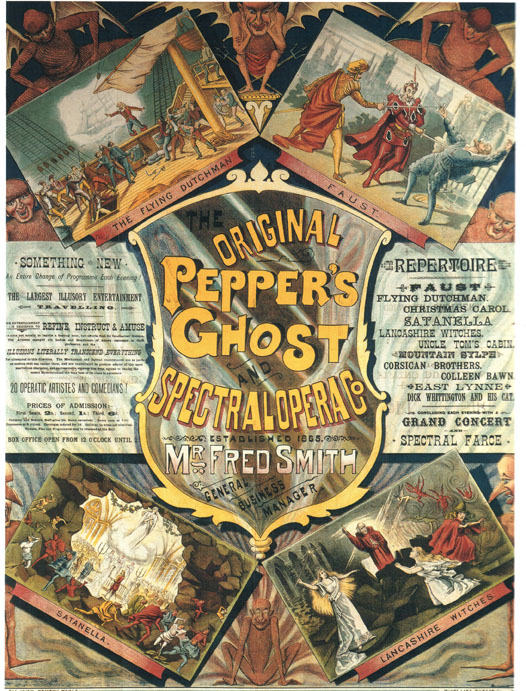
This poster from 1893, is from one of them: the now forgotten “Mr.Smith’s Original Pepper Ghost’s and Spectral Opera Company” (preserved in the London Public Record Office).
What exactly did a spectral opera company? They built the apparatus on and under the stage, then presented some sort of ghost variety show. It consisted in a selection of famous scenes from dramas, novels, or operas in wich at least a ghost included. We have of course some doubts on the acting talent of companies as Mr.Smith’s in playing the likes of Faust or Lancashire Witches. And we are more perplexed at the eventual singing abilities in selections from Flying Dutchman; or at the accuracy in the dramatization of literary classics as Uncle Tom’s Cabin or Christmas Carol.
But we firmly believe that the prestige was perfectly crafted, and the manifestations of spectres, evil or saints, was for the audience more thrilling at the times than any movie magic of today.

Saturday, December 23, 2006

Christmas Circuses


With a tribute to Bertram Mills

Few things are more connected to Christmas than a visit to the circus.
When I was a child, I had a great chance. In the 70s, Christmas circuses in Italy used to have the highest possible standard in the world. Stepping into one of those huge decorated big top, best if covered by recent snow, was for me a weird sensation. It felt as to step inside a christmas tree, or have a strange walk into a full life nativity diorama. The mysterious unfolding of the acts was a no minor pleasure of unwrapping toys and gift. And what gifts I was treated to, when at the circus!
I didn’t knew to be admiring legendary names: from the contorsions of Archie and Diana Bennett “directly from Las Vegas”, to the legendary Rastelli clowns; from Bulgarian teeterboard pioneers as Boitchanovi or Silagis, to cycling champions as Bertini, King Charles or New Dollys; the horse pyramids of the Caroli or Casartelli families; aerials from Miss Mara to the Flying Palacios, to the triple of Raul Jimenez…Elvin Bale…the Munoz on the wire; the risley icons Rios brothers; the lions of Darix Togni or the bears of Ursula Bottcher; the 25 elephants of Circo Americano; the lavish coreographies of Arturo Castilla or Liana Orfei, the water or ice circus pantomimes...
I can mention just few of the many I was used to see year by year, and all at few blocks from home.
But destiny, birth and age didn’t gave me the chance to know the best of all christmas circuses in history. I speak ofthe London Olympia circus created by Bertram Mills between 1919 and 1964. Only pictures and fading memories of few survivors are today remaining to describe this immense hall transformed for few week in the home of the best circus heroes of XX century. I think that for a child in London, this should have been better than a visit to Willy Wonka’s factory.
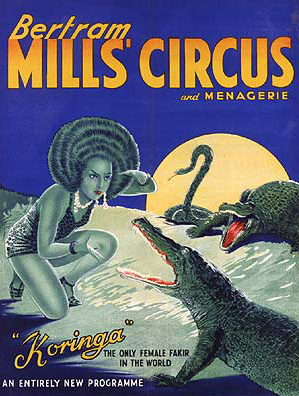
Beside the main circus hall, Mills used to build into the Olympia a menagerie, then the “fun fair” with his rides, a complete sideshow (mostly with Ringling attractions from overseas) including sometimes a lilliput village. An army of the greatest British clowns, the last heirs of classic pantomime, animated the shows. The trapeze net was all the time above your heads, remembering all the time the thrill of the circus. Sometimes Merle Evans was called as the band leader.You was sure to see the best animal acts in the world, and Willy Schumann was the equestrian director.
And the Queen, of course, came every year, and greeted each one of the performers backstage, from the unycicle juggler to the last of Ubangi savages.
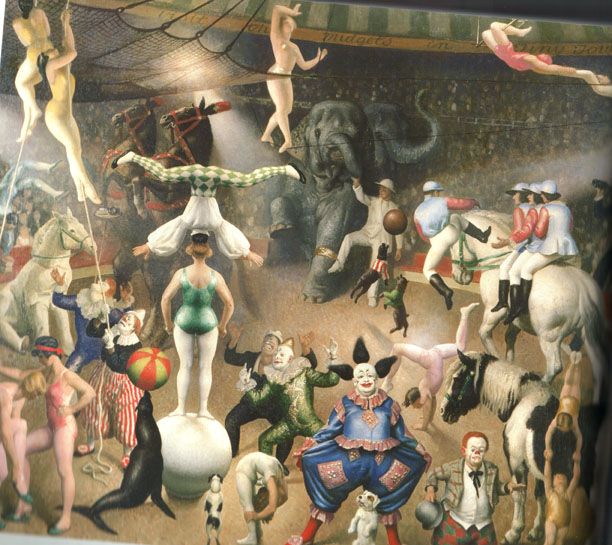
As a tribute, we offer here a couple of images remembering this Mills era. One is from the imagination of famous painter Dame Laura Knight, that used to visit the Olympia show: this is a partial view of her huge painting “Charivari” (1928).
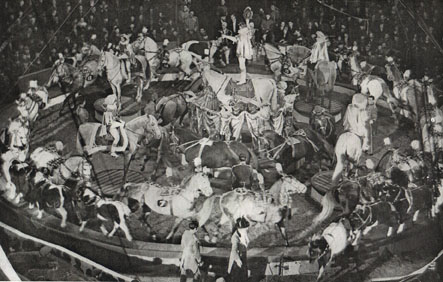
The other is a photo of the reality. Taken in the mid-30s, it depicts one of the incredible Schumann horse living carousels.
What about Christmas circuses today? The bests are actually in Germany, Switzerland, Holland, in temporary big tops or halls. And Big Apple at Lincoln Center in New York, of course. But if you wish to feel the real magic of a Christmas circus, the destinations are the two oldest circus buildings in the world: the Carrè Royal Theatre in Amsterdam, with the Knie family, and the Cirque d’Hiver in Paris, with the new generation of Bouglione dinasty. Wherhever you are, I guarantee that they both are worth the trip.

And Happy Holidays, of course.

Saturday, December 16, 2006

More Koringa

In 1937 Koringa was discovered by Cyril Mills in some French big top, and was booked at the London Olympia for the Holiday Season. Mr.Cyril remember in his memories that his legendary father Bertram Mills had some doubt, considering the act “someway borderline” . But an impressive advertising campaign was built, and the act was the success of the season.


Koringa’s act was basically the same of Blacaman’s: a first part of fakir classics as the sword ladder or the burial alive under the ring, then the hypnotism with reptiles: snakes before, than crocodiles.
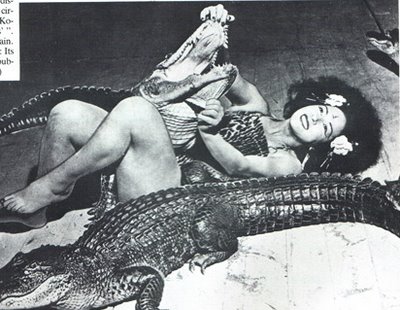


The following picture from the Mills program is eloquent in all the erotic stimulation of obscure fantasies that the British audience between the wars could have hidden under the icy curtain of a London Christmas.

Koringa was such a success, that the act was kept on tour by Mills for the following big top season.

Friday, December 01, 2006

Robert-Houdin

On the literary legitimization of legerdemain (celebrating two new editions of the old).


As in religions, the mytologies and legends of show-business are often started by biographies. Vocation and careers are said to be initiated at tender age by the noctural reading or the daydreaming of life and adventures of stage saints.We often forget that the so-called “father of modern magic” Robert-Houdin ( Jean-Eugene Robert, 1805-71) owes his worlwide fame more to the infinite editions and translations of his mémoirs, than to his effective performing career (shorter than other average long-life performers). His autobiography (Confidences d'un prestidigitateur- une vie d'artiste,1858) is a literary operation (enhanced by fiction) for a precise project: the social legitimation of magic elevated to the bourgeois “artiste” world from the outlaw vagabond jongleurs.
This vision evolved with more technical works. If later he wrote a treatise on gambling in the literary tradition of unmasking frauds (Les Tricheries des Grecs dévoilées ; l'art de gagner à tous les jeux, 1861), and after his career a pamplet on the built-in subterfuges of his haunted villa in Blois (Le Prieuré, organisations mystérieuses pour le confort et l'agrément d'une demeure,1867), more surprises was awaiting.
In the very last years of his life, he conceived two works that perhaps changed forever the concept of « magic literature ». Those two books ( Comment on devient sorcier. Les secrets de la prestidigitation et de la magie,1871, and Magie et physique amusante, postumous, 1877) are the first exemples of technical magic books not as pampleths to reveal “secrets” of sorcerers, nor simple pastimes. They are instead conceived as the divulgation of legitimate learning tools for everybody in the society willing to learn an harmless theatrical art.
For the first time, the subtle mechanics of hand dexterity and object mistification are described within the psycological frame of a true artistic context. A new art for a new world, when the industrial revolution was creating the concept of leisure, and the rise of photography was revolutioning the illusory reproduction of reality, the visual perception of the things and of the world. Monsieur Robert lived long enough to witness the progress of sophisticated science over simple mechanic. He slowly transformed himself from an horologist into an oftalmologyst. This contrast between the craft of automata and the evanescent mistery of new science is the most fascinating contribute of Robert-Houdin to the challenge of magic with the movies for her last “golden age”. It is a curious case if the Lumiere bros. photographic studio was installed in the floor above Robert-Houdin’s small theatre, and Georges Méliés inherited this same with his secrets.
Robert-Houdin books are the pillars on which the golden age of stage magicians was built between the XIX and XX centuries.
The erudite and boring notes above, may have stimulated some curiosities in bibliophily. An this brings us too into the subjects of actuality of the present post.
Until today, Robert’s books have been more or less availables, in various editions, but generally abridged. The complete editions have been preserved in some collection or libraries around the world.
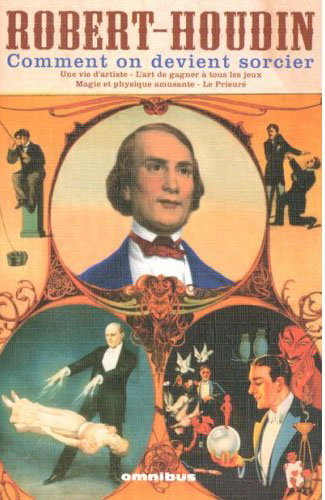
Today, two centuries after the pioneer’s death, those works are the object of two distincts publishing efforts. One is French, the other American. The French publisher “Omnibus” presented few weeks ago the first ever complete edition of Robert-Houdin four books. It is an economic paperback edition conceveid for the general audience (as the author’s intention was, before the rising of the “magic fraternity” hypocrisy), at the bargain prize of 24 Euros for more than 900 pages (check it on www.amazon.fr). In the last few days, a very beautiful essay on the books appeared on Le Monde with the prestigious signature of Christian Fechner. You don’t read French? Coincidentally, last October, the magic publishing house Miracle Factory (
http://www.miraclefactory.org/) animated by Toddd Karr, presented a very elegant and sophisticated English translation, rich in illustrations and enhanced with commentaries by experts.

A pedantic appendice to our notes: Robert-Houdin wrote also a treatise on oftalmology: Note sur de nouveaux instruments propres à l'observation des divers organes de l'oeil ainsi qu'à la manifestation des images entoptiques (1867) . It is not included in none of the two new edition, but we honestly thinks that it should not be a a remarkable loss for the readers.


Locations of visitors to this page